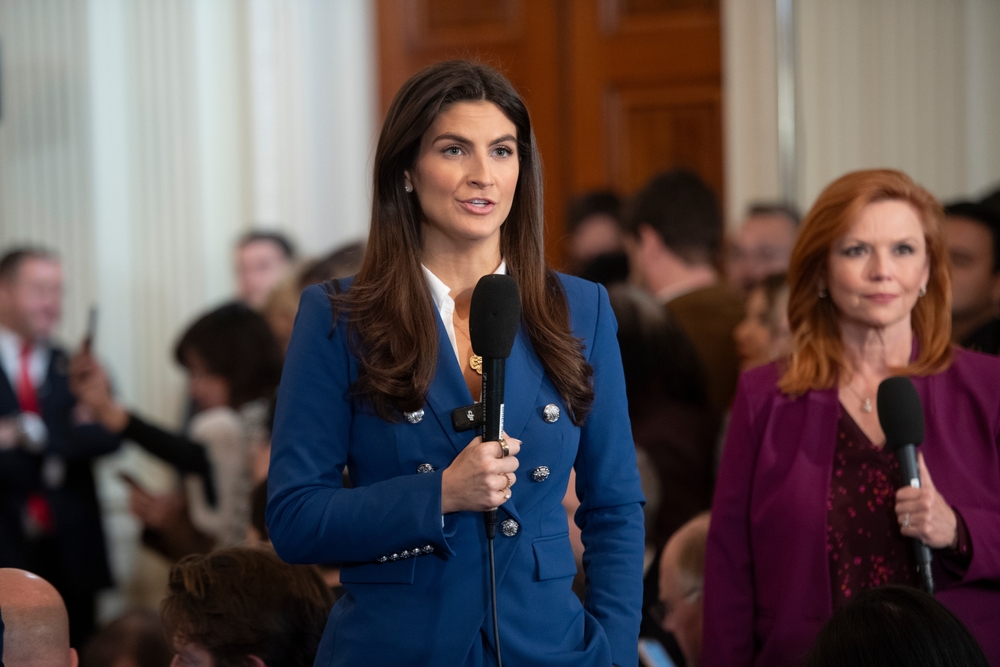
CNN anchor and White House correspondent Kaitlan Collins is choosing to keep the spotlight on journalism rather than personal attacks after President Donald Trump targeted her during the rescheduled White House Correspondents’ Association (WHCA) Dinner.
Speaking on The Daily Show with Jon Stewart following the event, Collins addressed the president’s comments with composure, saying she believes the criticism reflects frustration over her reporting rather than anything personal.
“The fact that I got an award for it really bothered him, clearly,” Collins said, referring to the WHCA Award for Excellence in Presidential News Coverage Under Deadline Pressure that recognized her reporting on a high-profile Oval Office meeting involving Ukrainian President Volodymyr Zelenskyy.
Instead of responding emotionally to the personal remarks, Collins emphasized that her priority remains asking difficult questions and delivering accurate reporting.
“I don’t want it to become about me,” she explained during the interview. “When those moments happen, it’s more important to remind people about the reporting, the questions being asked, and the answers—or non-answers—we receive.”
Trump Revives Longstanding Criticism
During his speech at the correspondents’ dinner, Trump congratulated Collins on receiving her journalism award before quickly turning the moment into a series of jokes aimed at the CNN journalist.
Among the comments was a comparison between Collins and transgender influencer Dylan Mulvaney, referencing Mulvaney’s widely discussed Bud Light promotional campaign that sparked significant public debate in 2023. Trump later shared a digitally altered image on social media that combined Collins’ face with imagery associated with Mulvaney’s campaign.
The president also repeated earlier remarks criticizing Collins for allegedly “never smiling,” a comment he has made on several previous occasions during White House exchanges.
Collins Keeps the Conversation on the Press
Despite the personal nature of the comments, Collins made it clear she has no interest in engaging in a public feud.
She noted that confrontational moments with the president are nothing new, describing them as a familiar part of covering the White House.
“This happens pretty regularly inside the Oval Office,” Collins said. “This was simply a much bigger stage.”
She also observed that the audience inside the correspondents’ dinner appeared noticeably quiet during Trump’s remarks, despite the room including many of his political allies and administration officials.
Stewart Praises Collins’ Composure
During the interview, host Jon Stewart described Collins as “unflappable,” pointing to her calm demeanor during often-tense exchanges with the president.
Collins responded by saying that journalists should avoid making themselves the center of the story.
Whether covering President Trump or former President Joe Biden, she said her responsibility has always been the same: focus on the reporting and continue asking questions that hold public officials accountable.
Support From CNN
CNN publicly backed Collins following the president’s comments, praising her professionalism and dedication to White House reporting.
In a statement, the network described Collins as a trusted journalist whose reporting consistently provides important context and insight for audiences across its platforms. CNN also reaffirmed its full support for both Collins and its broader news team.
Veteran CNN anchor Wolf Blitzer also applauded Collins, calling her “a true professional” and expressing pride in her recognition at the correspondents’ dinner.
Ongoing Tensions Between Trump and Collins
Trump and Collins have frequently clashed during press briefings and Oval Office events over the years, with many of their exchanges drawing national attention.
Despite the repeated criticism, Collins has continued to stress that the role of journalists is not to become part of the political narrative but to keep asking questions on behalf of the public.
Her latest appearance reinforced that message, underscoring her belief that journalism should remain focused on facts, accountability, and informing audiences—even when the scrutiny becomes personal.